The action item that returns to the next 1:1
A 1:1 commitment needs an owner, a visible state, and a place in the next session. Otherwise the meeting ends with agreement and no follow-through.
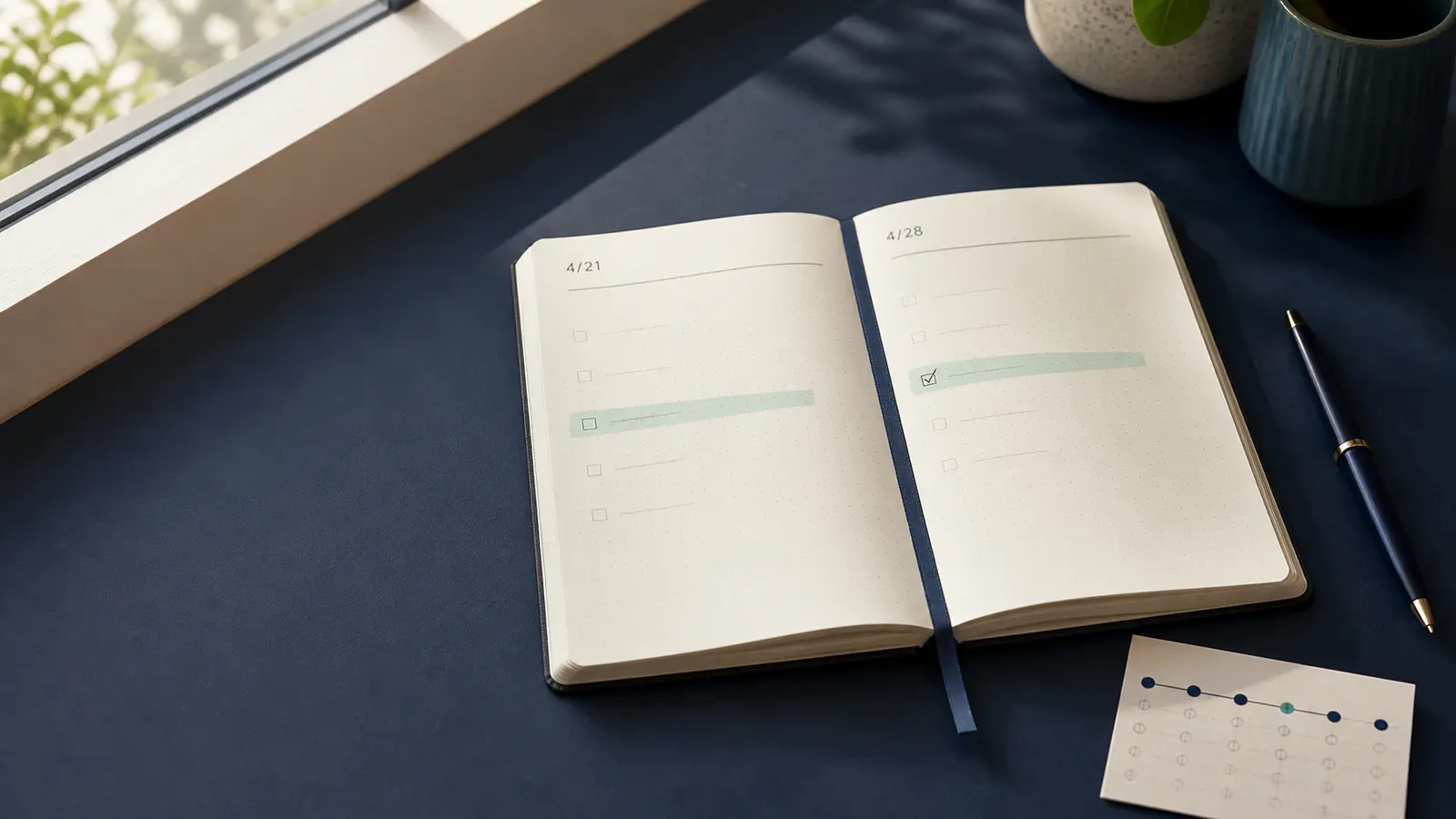
The most fragile moment in a 1:1 is often the final two minutes. The difficult topic has been named, both people agree that something should change, and the meeting ends on what feels like progress. Then the commitment is left inside the conversation.
By the next session, each person remembers a different version. The manager remembers agreeing to look into it. The direct report remembers a decision. Neither can point to an owner, a state, or a next step. The topic returns, but the commitment does not.
This is not a motivation problem. It is a handoff problem.
Agreement is not yet follow-through
People use several phrases to close a topic without noticing that they have left the work undefined: "we should revisit this," "let me see what I can do," or "we will sort it out." Those phrases are useful inside a conversation. They are weak records outside it.
A durable action item needs only a few concrete properties:
- a task specific enough that both people recognize the same outcome;
- one assignee, even when other people will help;
- a visible state, such as open or completed;
- a place where it will be read again.
The last property is easy to miss. A perfectly written task can still disappear when it lives in a note nobody opens. For recurring 1:1s, the natural place to read it again is the next session.
The next meeting is part of the action item
Treating follow-through as a separate task-management exercise creates unnecessary overhead. The manager copies notes into one system, the report keeps another list, and the 1:1 begins with both people searching for the latest version.
The recurring series already provides the review point. An open item from one session should remain attached to the manager-report pair and be visible when the next session starts. That makes the follow-up loop small:
- Capture the commitment while its meaning is still clear.
- Assign the person responsible for the next move.
- Leave the item open until the outcome exists.
- Read it at the next 1:1 and close, change, or continue it.
This is the workflow supported by action items and session history in 1on1 [source:internal]. The product keeps follow-through with the recurring pair instead of asking either person to reconstruct it from memory.
Write the smallest honest next move
Large action items hide uncertainty. "Fix the promotion path" may represent a real concern, but it is not a useful next move for one person between two sessions. The work may require several decisions, evidence from other people, and time the assignee does not control.
A smaller item preserves what can actually happen next: "Manager drafts the promotion criteria currently used by the team" or "Report lists two recent projects that demonstrate the missing scope." Those tasks do not pretend the entire issue will be resolved before the next meeting. They make the next conversation better informed.
The distinction matters because a 1:1 is not a project tracker. It is a recurring place to make sense of work, the relationship, and decisions that need attention. Action items should support that conversation, not consume it.
One owner does not mean one person does all the work
Assigning one owner can feel reductive when responsibility is genuinely shared. In practice, the owner is simply the person who will make sure the item has a readable state at the next review point.
They may collect input, ask for a decision, or discover that the original task was wrong. Any of those can be a valid update. What fails is ambiguity about who will bring that update back.
1on1 action items include an assignee and can be managed as work moves from open to completed [source:internal]. That is enough structure to preserve accountability without turning the meeting into surveillance or automated performance judgement.
A four-session test
You can test this loop without changing the process for a whole team.
Choose one manager and one direct report. For four recurring sessions, capture no more than two action items per meeting. Make each item specific, give it one owner, and begin the next session by reviewing what remains open.
At the end, inspect the record. Did vague agreements become clearer? Did blocked work return while it was still useful to discuss? Did either person spend less time reconstructing what had been promised?
The Free plan supports a pilot with one manager-report pair source. The point is not to prove that every conversation needs a task. It is to find out whether the commitments that matter can survive from one 1:1 to the next.
Next step
Test it with one manager and one direct report
Start free and keep this article context through the registration step.
Start free