Regular check-ins, yet your report still feels on their own
Support an autonomous report without hovering: agree which decision needs your help, what remains theirs and when to check back.
If your report feels unsupported despite regular check-ins, use the next 1:1 to agree where your help belongs. Ask about one decision they are carrying alone, choose a useful intervention together and say what they will continue to own.
A supervisor of four accountants described this tension in a public r/managers post. They reported daily check-ins and weekly 1:1s, yet their team still felt isolated. The supervisor recognised that broad questions about how things were going left them with little understanding of the issues. They wanted to become more involved without hovering.
That account gives a concrete reason to examine the conversation before adding another meeting. It does not tell you what your own report needs. Ask them.
Find the decision behind “everything's fine”
Try: “Which decision are you working through where my involvement would help?” Give them time to choose. Then ask what makes it difficult: missing information, competing priorities, access to someone else or uncertainty about their authority.
Stay with that decision long enough to understand the requested help. If the person wants a sounding board, taking the decision away from them would change the arrangement. If they need you to resolve a conflict with another team, another invitation to ask for help leaves the conflict with them.
You can make the boundary explicit with three questions:
- “Would you like me to think it through with you, make an introduction or take a decision that belongs to me?”
- “What would you like to keep handling yourself?”
- “When should we check whether this amount of involvement still fits?”
These are prompts to adapt together. Your report may want help you have not offered, or may need time to identify it.
Agree the smallest useful intervention
Consider a hypothetical engineering example: a developer owns a migration plan but cannot get another team to confirm a dependency. The manager agrees to secure a named contact by Thursday. The developer keeps ownership of the plan and technical choices. They agree to check the dependency at Friday's 1:1, with an earlier message if the contact falls through.
The useful detail is the division of work. Both people can tell whether the manager delivered the promised help, while the developer retains room to act.
Write the agreement in plain language: your action, their continuing ownership and the point at which you will revisit it. Ask whether that wording matches what they wanted before closing the conversation.
Bring your promise to the next 1:1
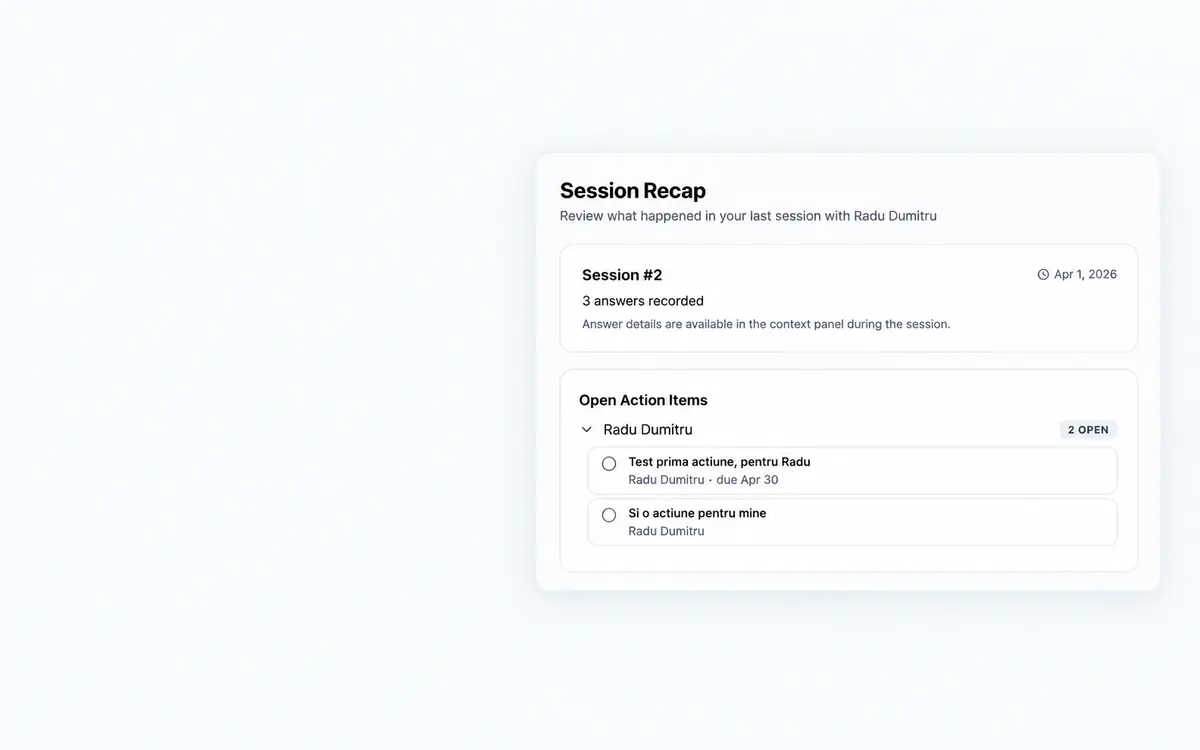
1on1 provides guided agendas, written session context, action items and recurring follow-up. Use that workflow to carry your own commitment into the next conversation. Start by checking what happened with the help you promised, then ask whether the agreed level of involvement is still useful.
If you missed your commitment, say so and agree what happens next. Software can keep an action available for follow-up; the introduction, clarification or decision still needs your work.
At your next 1:1, choose one current decision and agree the support boundary together. If keeping that agreement between sessions is difficult, explore the recurring conversation workflow in 1on1 with that specific need in mind.
Next step
Test it with one manager and one direct report
Start free and keep this article context through the registration step.
Start free