Do you need a recording of the 1:1, or an agreed written record?
A recording lets you replay exactly what was said. An agreed written record carries forward what you decided. Ask which job your 1:1 needs.
A recording and a written 1:1 record do different jobs. A recording lets you replay exactly what was said. An agreed written record keeps what you both decided, what is still open and who does what next, ready for the next 1:1. Choose by the job you need done, not by which tool has the better AI badge. Some 1:1s need both.
Exact words fade fast
Memory research favours the recorder on one point. After a short delay, people in a conversation “may recall from memory fewer than 20% of the specific ideas that were originally expressed.” In one study the same review cites, 128 participants recalled about 10% of the ideas from a 7-minute conversation, five minutes after it ended. The review adds that people “are much more likely to remember the gist of what was said than the exact words.”
So if the exact wording will matter later, notes won't hold it. If what matters is the gist (what you decided and what's next), a few written lines can.
Managers disagree, and both have a point
In a February 2026 r/managers thread, one manager argued for AI minutes because they help “remove bias from the minutes, which the author can’t avoid adding.” Another replied that “Having Ai there recording everything is a sure fire way to make sure your reports never feel comfortable speaking candidly about things.” Reddit sometimes blocks the page, so we checked both comments in an archived copy. They're two opinions, not a study.
Even a recording vendor treats this as a judgement call. Fellow's guide lists “Complete accuracy” and a searchable archive among the benefits, and says you can “query your entire conversation history with natural language.” It also advises: “Always get consent before recording, and give your direct report the ability to pause recording for sensitive topics.” And: “Some conversations genuinely shouldn't be recorded.”
Two questions before you choose
- Will anyone need the exact words later? A detailed walkthrough your report wants to rewatch, or a conversation where the precise wording matters. If yes, record it in a tool your company approves, and only if your report is comfortable with that.
- What must still be true at the next 1:1? Decisions, open questions, actions with an owner and a date. That needs a short written record you both can read and correct.
Two yeses means you need both. In a recurring 1:1, the second question comes up every time; the first only sometimes.
Test it on a made-up conversation
Before you commit to a tool, run a 10-minute practice 1:1 on something harmless, such as planning a talk for an internal meetup. If your company already approves a recorder, capture it there. Also write the agreed record together in three lines. An invented example:
Agreed: Ana drafts the talk outline by Friday.
Open: whether her team lead joins the rehearsal.
Next 1:1: start with the outline.
Then ask two things. Which one took less effort to make usable? Which one would you actually open before the next 1:1?
Where 1on1 fits
1on1 is the written side. It brings the agenda, written conversation record, action items, and prior-session context into one workflow for a manager and direct report, and carries action items and written context into the next conversation. Its AI works from the written 1:1 record, not from audio. If you need playback, keep the recorder for that.
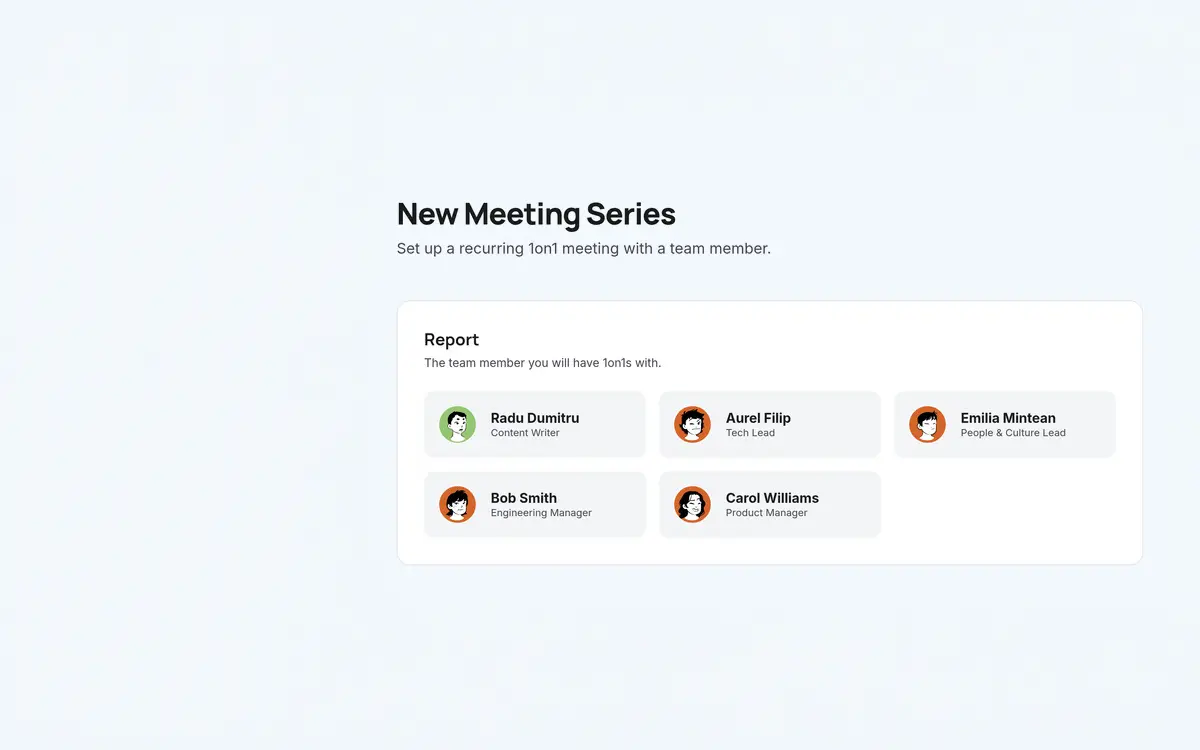
Before your next 1:1, answer the two questions for that conversation. If the answer is the agreed record, set up a recurring 1:1 in 1on1 and start the series with the three lines.
Next step
Test it with one manager and one direct report
Start free and keep this article context through the registration step.
Start free